


It Spits! What is a White Hole?
- Mar 20
- 7 min read
Updated: Mar 21
Today, the existence of black holes has been proven, but the existence of these mysterious cosmic vacuums has led us to ask other questions: "Could there be white holes?" or "If there are black holes, why aren't there white holes?" When we think about it, the existence of white holes might seem logical because our universe is like a patient with OCD. If there is matter, there must be antimatter. So what is a white hole, is it real, and does it obey the laws of space? Let's take a look at what a white hole is.
Contents
What is a white hole?
A white hole, as its name suggests, is the exact opposite of a black hole: instead of drawing in surrounding particles, it releases matter into space. However, since white holes also have mass and gravitational pull, they will attract matter towards themselves. But the matter will be repelled before it can enter the event horizon (the area from which light cannot escape). Because they are the opposite of black holes, their event horizons are reversed, meaning they do not allow entry and repel matter. Furthermore, the existence of white holes depends on the existence of black holes because, theoretically, they eject matter that has been pulled into a black hole.
How do white holes work?
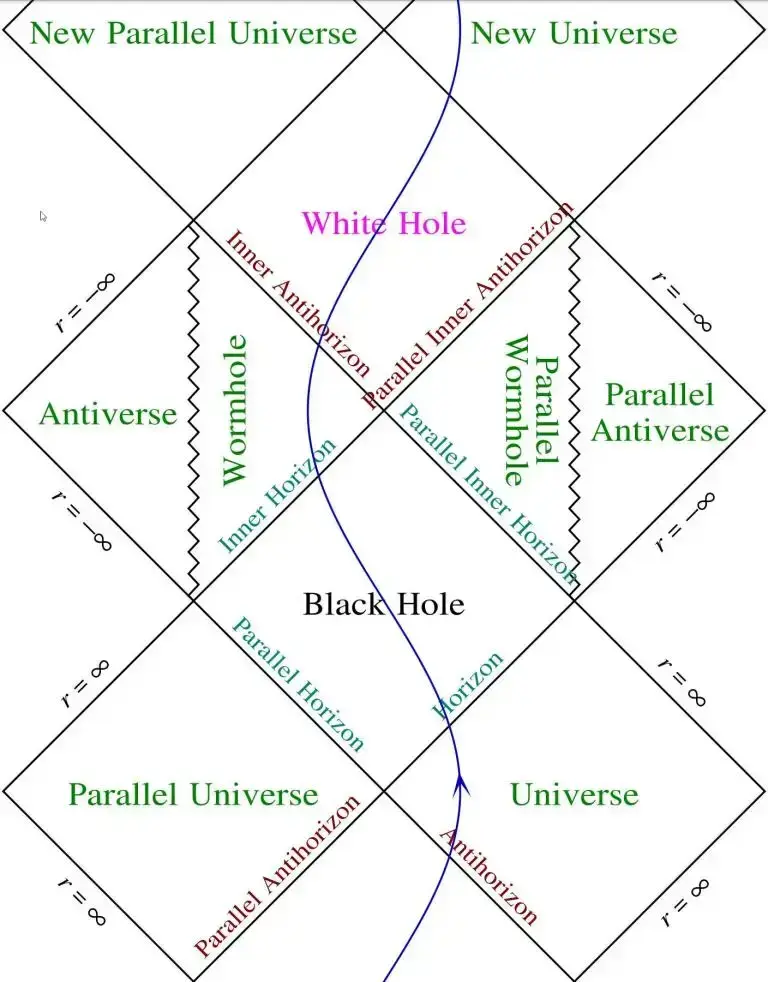
Before learning how white holes work, it's necessary to know a few things about black holes. In a Schwarzschild black hole, falling into it takes you to the singularity and darkness. But in a charged Reissner-Nordstrom black hole, as you fall into it, light can eventually catch you and tunnel you to another part of the universe. The exit to the other side is the white hole itself.

Theoretically, there could be a point of convergence between black holes and white holes.
You can think of white holes as inverted black holes. But let me ask you a question: where does matter go when it falls into a black hole? The answer is normally "the singularity at the center," but that puts an end to the white hole debate. A frequently considered possibility is that the singularity might not only be a point where matter "goes" after falling into an event horizon, but also a point where matter "emerges." Rather than the "end" of the story for matter, it could be the "beginning" of a new and different story.
Was the Big Bang caused by a white hole?
There are two ideas about this: The first is that it's impossible for the Big Bang to have started with a white hole. The most concrete evidence for this is that white holes require a vacuum of space to exist. White holes cannot appear in a place where nothing exists.

According to some theories, matter swallowed by a black hole is released as a white hole in another universe, representing completely different information and potentially marking the beginning of a new universe. Imagine a number "1" swallowed by a black hole in a universe where the arrow of time moves forward; this number becomes "0" upon entering the event horizon, and "-1" upon exiting the white hole into the new universe.
Another theory suggests that the existence of a white hole implies that the future is predetermined. What characterizes a black hole is an event horizon that can only be crossed from the outside in. Life lines that arose in the past may or may not intersect with this horizon. Life lines extending into the future cannot arise at the horizon. Now consider the opposite: a white hole. Life lines that arose in the past cannot intersect with the horizon because the existence of that white hole is predetermined. Nothing can enter it. However, this violates the principle of causality: the future determining the present. Yet, some theories argue that a massive white hole caused the Big Bang and that our universe hangs suspended at the event horizon of that hole.
Do White Holes Have a Singularity?
White holes, like black holes, must have a singularity and an event horizon at their centers. This is because nothing in the universe, except photons, can exist without mass. Therefore, white holes also have mass and gravity. These are properties that come with the singularity at the center.
Is it possible to enter a white hole?
Entering a white hole would require time travel to the past. This is impossible. In entropy (randomness or uncertainty), the arrow of time always moves forward for complex objects. Entering a white hole would be like going back to one's birth, so it is impossible, at least in our universe.
Is the White Hole Real?
According to Einstein's general theory of relativity, white holes are possible, but they cannot form in our universe. This is because time is a unidirectional system in every universe in the multiverse. In our universe, time can only flow forward, which prohibits the creation of a white hole. On the other hand, in our sister universe in the multiverse, time can only flow backward, which prohibits the existence of black holes but opens the door to the existence of white holes. However, since the existence of white holes is purely theoretical, their reality has not been proven.
Has a white hole ever been observed before?
Although not entirely clear, a gamma-ray burst lasting 100 seconds was observed in 2006. The reason for specifying 100 seconds is that this burst should have been caused by a supernova, but there was no supernova. In 2011, the claim was made that it was a white hole.
How do white holes form?
Theoretically, information swallowed by a black hole would disappear into the universe, but according to quantum physics, it cannot disappear and must be found somewhere. However, since the swallowed information cannot obey the laws of entropy (due to singularity), time cannot flow forward for it. This information has two fates: either time begins to flow backward for it, and as the arrow of time moves backward, it exits the black hole into a different universe, or it returns to the universe from which it was swallowed as pure energy via Hawking radiation. Source
The formation of a white hole requires a universe where the arrow of time flows backward and a black hole in a universe where the arrow of time flows forward. When matter enters the event horizon of a black hole, it ceases to exist in that universe; the arrow of time stops for it, and it is completely erased from that universe. Now let's reverse this arrow and consider the central singularity of the black hole as a gateway. We now have an exit to a universe where time flows backward. This is the kind of situation necessary for the formation of white holes.
What is the relationship between white holes and wormholes?
Both white and black holes have a singularity at their centers. Theoretically, a wormhole connects these singularities, making passage to the other universe possible. How? The Schwarzschild metric accepts both positive and negative square root solutions for geometry. The entirety of Schwarzschild geometry consists of a black hole, a white hole, and two universes connected by a wormhole at their horizons.

The ends of the flow points represent the singularities of the white and black holes, and exactly between them (the red ring) is a wormhole that facilitates the flow between the two singularities.
General Relativity has time symmetry. It doesn't know the second law of thermodynamics or which direction cause and effect go. But we do. The solution to the negative square root outside the horizon represents another universe. The wormhole connecting two separate universes is known as the Einstein-Rosen bridge.
White Hole Theory and Studies Conducted
The theoretical origins of white holes can be traced back to Russian cosmologist Igor Novikov in 1964. Building on the work of German physicist Karl Schwarzschild, who described the spacetime geometry of the empty space surrounding any spherical mass, Novikov proposed the idea of white holes as a kind of cosmic twin of black holes, as part of his solution to Einstein's field equations. In 1960, mathematician Martin David Kruskal expanded on Schwarzschild's work to include a reflection of the black hole singularity, but it was Novikov who transformed this into the concept of white holes.
Schwarzschild's solutions to Einstein's field equations included the prediction that if a mass were compressed within a critical radius (the Schwarzschild radius), its gravity would become so strong that even light could not escape—in other words, it would transform into a black hole. However, Schwartzschild's definition also included the possibility of a theoretical "twin" for the black hole between the event horizon and a theoretical "negative" version of the singularity, and the curves in spacetime that we now call wormholes, through which objects in space could theoretically pass to traverse vast distances almost instantaneously.
Until recently, physicists treated the possibility of white holes as a mathematical exercise. White holes were considered mathematically possible but impossible in "real life." One reason for this was that no one had actually figured out a mechanism for how they would form. A black hole forms when a star collapses, but conversely, a black hole exploding into a star violates the laws of entropy, meaning the arrow of time moves backward instead of forward.
Another theory suggests that white holes are not twins of black holes, but rather what happens to a black hole after its death, albeit for a very short time. However, the work of physicist Stephen Hawking has shown that black holes can actually emit thermal radiation (Hawking radiation), which results from quantum vacuum fluctuations near the black hole constantly transforming into pairs of particles and antiparticles. As the positive particle escapes, the negative antiparticle falls in, causing the black hole to lose mass. Hawking radiation reduces the mass and rotational energy of black holes over time and could theoretically cause a black hole to evaporate.
However, this raises a number of questions. One of them is, if a black hole can evaporate and disappear, what happens to the information it swallows? According to general relativity, this information cannot escape, and according to quantum mechanics, it cannot be erased. According to some theoretical physicists, the answer is that it disappears in a wormhole and emerges in a white hole.
The initial view of black holes, proposed in the late 1980s, can be interpreted as spillovers on the natural state of classical white holes. Some researchers suggest that black holes are formed by a massive explosion in the core, creating a new universe that is an expanded version of the main universe. They predict that when a black hole forms, another massive explosion will occur in the core. This massive explosion creates a new universe that extends beyond the entire existing universe.


