


What is a Black Hole and How Does it Form? (All the Mysteries are Here!)
- Mar 20
- 9 min read
Updated: Mar 21
The mystery of black holes remains a big question mark for us humans. We don't know if these vacuums of space are destructive machines or gateways to other universes. Nor do we think the universe will wait for us to evolve and discover black holes. So, what is a black hole, how does it form, and do we know enough about its properties? At least partially. Let's learn comprehensively what these wild Dyson vacuum cleaners of the universe are all about!
Contents
What is a black hole?
A black hole is a massive, vacuum-like structure that forms at specific points in the universe , capable of swallowing everything, including light— the fastest object— without even blinking . While it's thought that black holes are composed of dark matter when viewed from their core, they are actually made entirely of normal matter.
How does a black hole form?
Black holes form when massive stars collapse towards their centers and explode due to pressure. The explosion of a star with 20 solar masses has a 40% chance of creating a black hole, while this rate increases to 100% for a star with 60 solar masses. Additionally, the collision of two neutron stars can also create a black hole.

For a black hole to form, a star must succumb to its own gravity. As a result, the elements at its core begin to collapse inward . Thus, the electrons around the atoms get closer to each other, and the atoms begin to repel each other. This results in a massive energy explosion . After this explosion, a compressed nucleus remains, and if the mass of the exploding celestial body is large enough, it transforms into a singularity, becoming a black hole.
How are black holes measured?
The definition of black holes depends on only three parameters: mass, electrical charge, and angular momentum. We owe these three parameters to Werner Israel's "no-hair theory," which he proposed in 1967. Other properties of black holes, such as their size and shape, are determined by these parameters.
The Structure of Black Holes
A black hole consists of 6 parts:
Event horizon: The region from which light and other matter cannot escape.
Singularity: The region at the very center of a black hole where gravity is presumed to be infinite.
Ergosphere: The rotating region of black holes before they reach the event horizon.
Photon Sphere: The line outside the event horizon where gravity is so strong that it causes light to spin.
Accretion disk: A structure formed by the orbital motion of surrounding material due to the gravitational pull of a black hole.
Jet streams: The general name for material that escapes a black hole's orbit at jet speed. They occur in quasars.
Do Black Holes Rotate?
Yes, everything in the universe is created by gravity bringing matter together. Even the slightest gravitational force indicates that the object is rotating.
Do Black Holes Move in the Universe?
Because black holes are collapsed stars, they behave like stars and move through space.In 2014, Spanish scientists found a black hole in the constellation Lacerta orbiting a Be-class star.
Do Black Holes Grow?
Yes, black holes can grow by pulling in nearby gas, dust, and stars .
How does a black hole disappear?
Black holes can lose mass over time through an energy escape called Hawking radiation . Energy escaping from the center of the black hole gradually shrinks it, and eventually the black hole disappears.
How long does it take for a black hole to disappear?
Because Hawking radiation is not a very rapid phenomenon, it would take approximately 10 billion years (10,000,000,000 years) for an average-sized (100 - 100,000) black hole to disappear.
What's Inside a Black Hole?
So what's inside a black hole? Actually, nothing, because the inside of a black hole is completely devoid of the concepts of space and time. The only reason for this is that everything is pulled to a single point, a singularity, by gravity and trapped there.
What happens if we enter a black hole?
So what happens if a black hole pulls us in? In a perfectly logical scenario, you'd die before even reaching the event horizon. Gravity increases as you get closer to the center of the black hole, and its kinetic energy emits X-ray radiation. Even if the radiation doesn't kill you, the tidal effect—the force exerted by the center as it pulls you towards itself—would tear you apart.
But let's imagine that none of the previous scenario happened. You were pulled into the black hole and you are at the event horizon. The concept of time no longer exists for you because there is no light, meaning time does not flow. To someone observing you from the outside, your image suspended in the air remains there because the light is trapped. Meanwhile, you also see the universe flowing past your eyes. Because every hour you spend inside the black hole is equal to 100,000,000 Earth years.
Theories about the interior of black holes.
Many different theories about black holes have been put forward so far:
Cloning: You are scorched as you enter the event horizon, and anyone observing you would consider you dead. However, if you don't die upon entering the black hole, this indicates that you are neither alive nor living.
Spaghetti-like appearance: When you enter the event horizon, gravity becomes so strong that it flattens you.
Time Travel: The concept of time works differently in black holes. When you enter and exit a black hole, you are essentially traveling through time.
Escape from a White Hole: Theoretically, you escape from a white hole that spits out everything swallowed by black holes into an alternate universe.
Types of Black Holes
There are five types of black holes in our universe:
Primordial black holes
Intermediate-mass black holes
Stellar-mass black holes
Supermassive black holes
Quasars
Primordial Black Holes
Black holes are the least massive objects in the universe, but their existence has not yet been proven. They are thought to have formed in the Big Bang and are very small in size.
Stellar-Massive Black Holes
Black holes are defined as having masses ranging from 3 to 20 solar masses. They are formed when a star collapses in on itself and can be observed through supernovae or gamma-ray bursts.
Intermediate Mass Black Holes
Intermediate-mass black holes are those with masses ranging from 100 to 10,000 solar masses. Their existence has been recently proven. In the 1970s, it was suggested that intermediate-mass black holes formed in globular star clusters, but observational technology to support this hypothesis was lacking. In 2019, the collision of two black holes with masses of 85 and 65 solar masses resulted in the formation of a 142-solar-mass black hole, and this merger emitted a gravitational wave signal of 8 solar masses. Observers who detected this signal proved the existence of intermediate-mass black holes.
Supermassive Black Holes
Supermassive black holes have masses exceeding 100,000 solar masses and can reach up to several billion. The tidal effect of supermassive black holes is weaker than that of smaller ones. The width of the event horizon is inversely proportional to the strength of the tidal force. This is because the centers of smaller black holes are closer to the event horizon, while those of supermassive black holes are further away. Therefore, unless you fall deep into the event horizon of a supermassive black hole, the tidal effect won't tear you apart.

Quasars
A quasar is an extremely bright, active galactic nucleus. In its simplest form, it is a black hole from which energy is ejected from both sides. The emission from the nucleus is driven by a supermassive black hole with a mass ranging from millions to tens of billions of solar masses, surrounded by a gaseous accretion disk. These jets occur as matter rapidly escapes from the event horizon.
The Collision of Two Black Holes and Its Consequences
If two black holes get so close that they can't escape each other's gravitational fields, they merge to form a larger black hole. This event is so violent that it causes significant fluctuations in the fabric of space.

How does a black hole swallow a star?
Any star caught in the gravitational pull of a black hole is gradually drawn towards it. Due to the intensity of the gravitational pull, it begins to stretch and, as it gets closer, it explodes, forming a spiral cloud of gas around the black hole. This cloud, resembling a snail shell, is pulled towards the center.
How to observe a black hole?
Black holes cannot be directly observed with telescopes that detect x-rays, light, or other electromagnetic radiation. Therefore, there are two different ways to observe black holes: through their gravitational pull and the interaction of surrounding matter.
As an example of how to observe the effects of gravity, we see an empty point at the center of the Milky Way where all the stars seem to revolve around a very dense mass. We understand that this point is a black hole from its gravitational force.
The interactions of matter occur when matter falls into a black hole. As matter falls in, it settles into a disk that can become very hot around the black hole. Some of the energy released during the inward fall is converted into light, which we can see as, for example, X-rays.
The First Photograph of a Black Hole Ever Taken
Observations of the Messier 87 (M87) black hole, located 54 million light-years from Earth in the constellation Virgo, began in April 2017 and its photograph emerged in 2019:

How was the first photograph of a black hole taken?
Capturing an image of a black hole is incredibly difficult. However, the Event Horizon Telescope Collaboration (EHT) has brought together eight radio observatories to create a "super Earth telescope." The collaboration's name is inspired by the black hole's event horizon. Although we cannot see the event horizon itself because it does not emit light, there are glowing gases swirling around the black hole. These gases "shadow" the black hole, making it visible. The image of the Sagittarius A* black hole, following Messier 87, was taken in this way.
All Black Hole Photos Ever Taken
There are only two photographs of a black hole ever taken. These two real black hole photographs are:
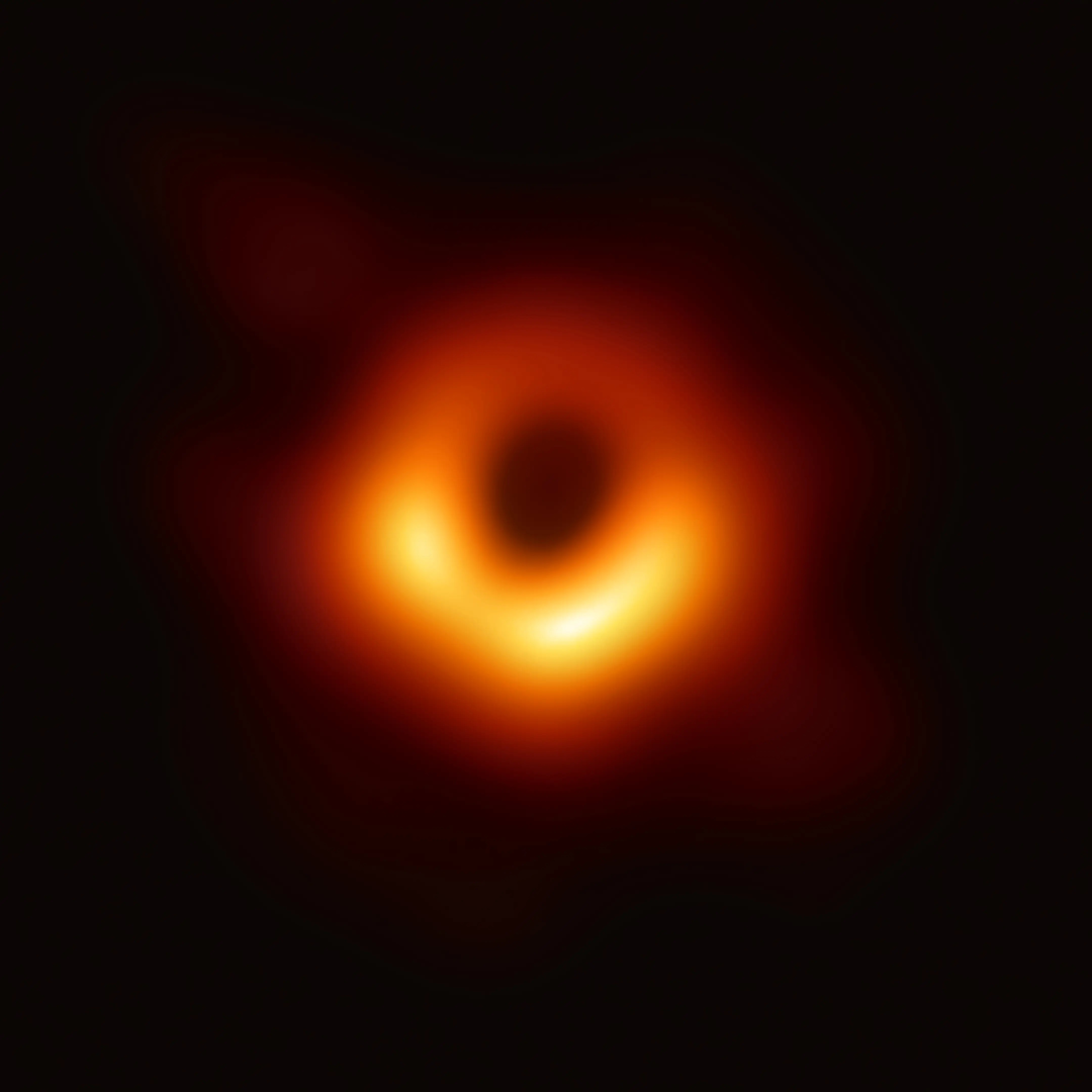
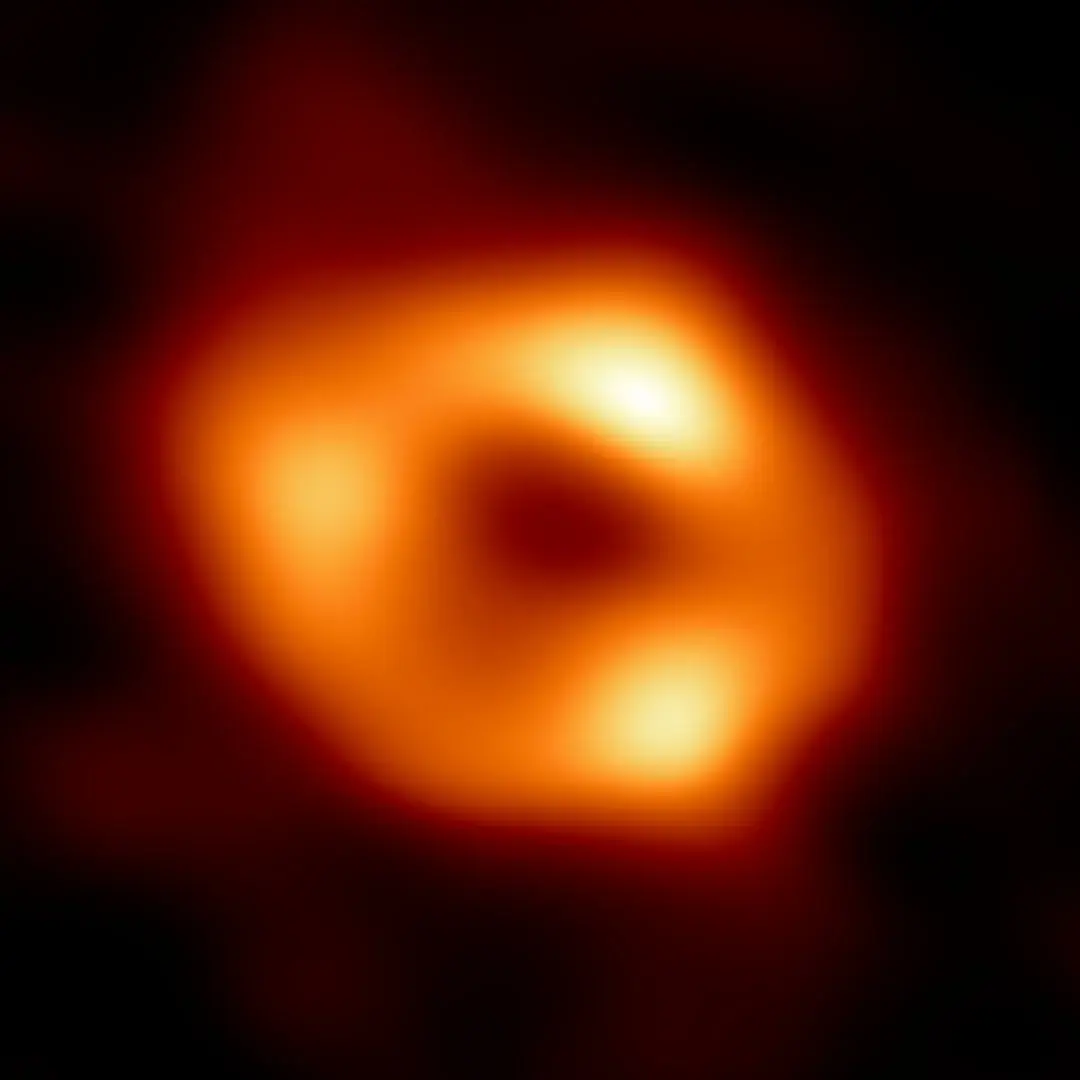
First captured photo of Messier87 (left) - First captured photo of Saggitarius A*
The Sound of a Black Hole Captured by NASA
On the other hand, NASA recorded the sound of a black hole in 2003. Turn the volume down a bit while listening because the sound coming from that black hole isn't very pleasant!
How did NASA record the sound of a black hole?
NASA used the swirling mass of hot gas at the center of the black hole to record its sound. Space is a solid vacuum, but this is not the case in regions where gases are dense (such as supernovae). Sound, being a kinetic wave, propagates through vibration, and the presence of gases makes this possible. This is how the sound of a black hole was captured.
The Closest Black Hole to Earth
According to the European Space Agency (ESA), the closest black hole to Earth is Gaia BH1, which is 1,560 light-years away. Don't let that scare you, because 1,560 light-years is a very long way off, and it's not moving towards us. Since it and its star orbit each other, it's unlikely to get close.
Gaia BH1 also holds the title of the smallest black hole in the universe because its mass is three times that of the Sun.
The Farthest Black Hole from Earth
The most distant black hole from Earth, and also the oldest black hole in the universe, is the quasar ULAS J1342+0928, located 13 billion light-years from Earth. Estimated to have formed 700 million years after the Big Bang, this quasar is located in the Boötes constellation and has a mass 800 million times that of the Sun.
The Largest Black Holes in the Universe
The largest black hole in the universe is Phoenix A, located in the Phoenix Cluster. Situated 8.61 billion light-years from Earth, this black hole has a mass of approximately 100 billion solar masses. For comparison, the Sagittarius A black hole at the center of the Milky Way galaxy has a mass of 4 million solar masses.
The second largest black hole in the universe is Ton 618. Actually, Ton 618 isn't a black hole at all, but a quasar. Located 10.4 billion light-years from Earth, this massive structure has a mass equivalent to 66 billion solar masses.

What would happen if you had a black hole in your pocket?
In short, the Earth would simply disappear. A black hole small enough to fit in your pocket would have a mass slightly greater than the Earth's. Before you even realized it, it would pull your atoms in, tearing them apart, and begin to fall towards the Earth's center, "eating" the Earth from within. As this fall occurred, the Earth would try to adapt to the black hole's gravitational field, taking on a new rotation. Then the Earth would become a complete gas disk, and the Moon's orbit would become elliptical. However, the other planets in the Solar System would continue to orbit. Eventually, this black hole would begin to orbit the Sun in place of the Earth. That's exactly what it means to come from the mountains and drive out those already in the garden!


