


Saturn's Mysterious Child: Everything About Titan Satellite
- Mar 22
- 7 min read
Imagine that you are the second largest planet among the eight and that you have 285 moons. But among your children, only seven of them attract the attention of those living on the planet 1.5681 billion km away. I think we can say we are dealing with a special situation? Of course, those living on Earth cannot be blamed for their skepticism, because predictions that life might exist within your child named Titan are being made and researched from miles away. Of course, besides its potential for life, what makes Saturn's moon Titan so special? Fasten your seat belts, and let's fly to Titan!
Contents

What Kind of Satellite is Titan?
Titan is not only Saturn's largest moon but also the only celestial body in the Solar System besides Earth that possesses stable liquid layers (lakes and seas) on its surface. However, what flows here is not water, but methane.
This giant moon, which is 40% larger in volume than the planet Mercury, remained a mystery for a long time due to its dense nitrogen atmosphere. With the landing of the Huygens probe on the surface in 2005, it became clear that Titan is an active world shaped by methane rain, ice boulders, and river-like features.
How Was the Titan Satellite Formed?
Titan formed approximately 4.5 billion years ago through the collision and coalescence of materials within the "sub-nebula" surrounding the gas and dust cloud that gave rise to Saturn.During its formation, it incorporated building blocks that originated from the cold outer regions of the solar system and contained abundant ammonia and water ice. The heat generated by the decay of radioactive elements in its interior enabled the satellite to differentiate into layers and caused the ice at its core to melt, forming an underground ocean.
Does Titan Have an Atmosphere?

Titan is the most notable satellite in the Solar System with a thick and dense atmosphere, and this atmosphere is even denser than Earth's. The atmospheric pressure at the surface is 1.5 bars, which is 50% higher than the pressure at Earth's surface. Although this dense gas layer completely obscures the satellite's surface to visible light, it allows surface features to be seen using radar devices.
Layers in Titan's Atmosphere
The Titan atmosphere consists of the troposphere, which extends to approximately 40 km above the surface, followed by the stratosphere, mesosphere, and outermost thermosphere. Cloud formation and precipitation occur in the troposphere, where the methane cycle takes place; in the stratosphere, a chemical haze layer forms through the breakdown of methane molecules by ultraviolet rays from the sun. This orange haze determines the satellite's characteristic color.
Gases Found in Titan's Atmosphere
The Titan atmosphere consists of 95% molecular nitrogen (N2) and approximately 4.9% methane (CH4) gas. The remaining small fraction contains complex hydrocarbons such as ethane, acetylene, and propane, as well as nitrogenous compounds like cyanoacetylene. This chemical richness arises from reactions between sunlight and methane and nitrogen, and provides a unique laboratory for "prebiotic chemistry" (chemistry before life) research.
What is the Mass of Titan?
Titan's mass is approximately 1.3452 × 10²³ (134 sextillion) kilograms. This value is calculated by measuring the deviations in the orbits of space vehicles such as Voyager and Cassini that pass by the satellite. Titan is the second most massive moon in the solar system, after Jupiter's moon Ganymede, and is approximately 1.8 times heavier than Earth's moon, the Moon.

What is the Surface Area of Titan?
Titan's total surface area is approximately 83 million square kilometers. This figure corresponds to approximately 16% of Earth's total surface area.The majority of this vast area consists of ice deserts, organic sand dunes measuring hundreds of meters in height, and liquid hydrocarbon seas in the polar regions.
What is the Circumference of Titan in Kilometers?
Titan's equatorial circumference is approximately 16,173 kilometers. This satellite, with an average diameter of 5,150 km, is larger than the planet Mercury (4,879 km) when measured by diameter. If Titan orbited the Sun directly instead of around a planet, its size would give it planet-like characteristics.
Where Does the Name Titan Come From?
The name Titan derives from the giant lineage of "Titans" in Greek mythology, who ruled the world and were the ancestors of the gods. Christiaan Huygens, who discovered the moon in 1655, simply called it "Saturn's Moon". The modern name was proposed in 1847 by Sir John Herschel, who gave mythological names to the seven known moons of Saturn.
What is the Internal Structure of Titan?

At the center of Titan is a core composed of silicate rock and iron with a radius of approximately 2,000 km. This core is surrounded by layers of high-pressure ice. Above this ice layer, it is considered with strong evidence to exist a global subsurface ocean consisting of ammonia-rich liquid water that supports the hard ice crust on the surface from below.
What is the Temperature of Titan's Core?
The core temperature of Titan is estimated to be around 1000°C. This heat originates from the residual energy left over from the satellite's formation and the decay of radioactive elements within it. However, this temperature cannot reach the surface due to the satellite's thick layers of ice and water; therefore, the surface temperature remains steadily at -179 degrees.
Titan's Orbit
Titan follows an orbit that averages 1,221,870 kilometers from Saturn's center. It completes one full orbit around Saturn in 15 days and 22 hours according to Earth time. The rotation period around its own axis is also equal to this duration. This causes Titan to always present the same face to Saturn, just as the Moon does to Earth. In other words, Titan also possesses a gravitational lock.
What is Titan's Axial Tilt?
Titan's axial tilt is very small, and the moon is tidally locked to Saturn. However, due to Saturn's axis tilt of approximately 26.7 degrees, seasons also occur on Titan. During Saturn's approximately 29.5-year orbital period around the Sun, Titan experiences four seasons, each lasting approximately 7 years. During this period, methane precipitation and the distribution of liquid hydrocarbons vary between the poles.
Does Titan Have a Magnetic Field?
Titan does not have its own intrinsic magnetic field. However, since it orbits within Saturn's massive magnetosphere, it is protected by the planet's magnetic lines. During periods of very strong solar storms, Titan sometimes moves outside Saturn's protective shield and is directly exposed to the solar wind, in such cases, gas escapes into space from the outermost layers of its atmosphere.

History of Titan's Discovery and Research
Discovery of Titan

Christiaan Huygens discovered Titan on March 25, 1655, using the telescope he developed. This discovery was a continuation of observations inspired by Galileo Galilei's discovery of the moons of Jupiter. When discovered, Titan was named "Saturni Luna" (Saturn's Moon) and remained Saturn's only known moon for a long time.
In 1847, John Herschel named this satellite "Titan" inspired by the giants in Greek mythology.
First Missions to Titan
The first close observations of Titan began with Pioneer 11 in 1979. This mission confirmed Titan's low temperature and thick atmosphere but provided no details about the surface. In 1980, Voyager 1 changed its course to make a close flyby specifically to study Titan. Thanks to this mission:
The atmosphere is largely composed of nitrogen
complex organic compounds are present in the upper atmosphere
has been understood. Voyager 2, on the other hand, passed by Titan from a greater distance and provided limited data. However, none of these missions could directly observe Titan's surface because its thick atmosphere concealed everything.
The Cassini-Huygens Era
The real revolution came with the Cassini mission. Cassini, which studied the Saturn system between 2004 and 2017, made 127 close passes over Titan and mapped its surface in detail using radar and infrared systems.
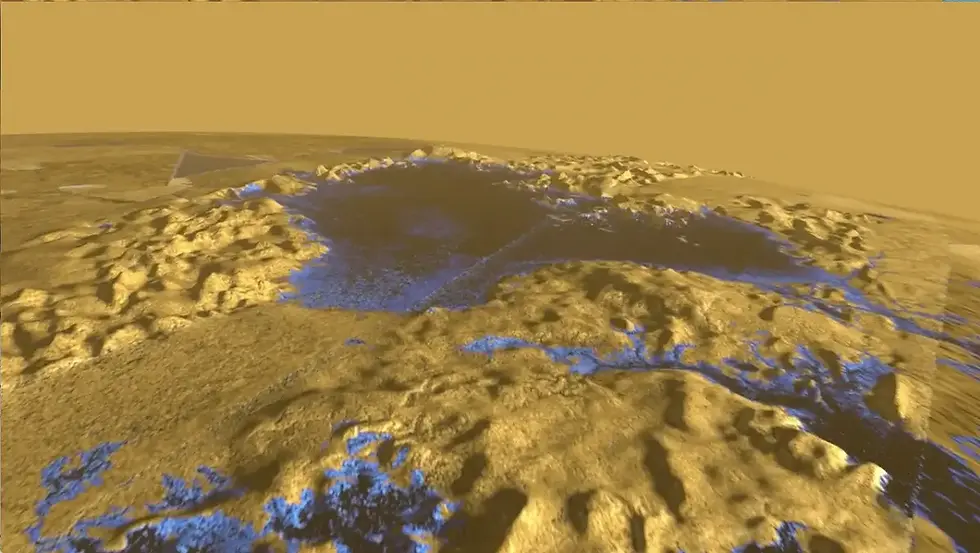
Thanks to these observations:
Large sand dune areas
Ice mountains
And most importantly, methane and ethane seas (especially Kraken Mare) were discovered
In January 14, 2005, the Huygens probe landed on the surface of Titan. This marked the farthest landing in human history. Huygens revealed pebble-like surfaces composed of ice, dried-up river beds, and landscapes shaped by methane rain.
Current Research about Titan
Although the Cassini mission ended in 2017, the data collected is still being analyzed. Titan remains a focus of the scientific community due to the following reasons:
Possibility of an underground ocean
Complex organic chemistry in the atmosphere
Seasonal methane cycle
Although some recent studies suggest that Titan's internal structure may be more complex and layered rather than consisting of a single, global ocean, the general consensus still favors the existence of a large subsurface ocean. Telescopic and remote observations continue to monitor seasonal changes and atmospheric movements on Titan.
Future Missions for Titan Moon
Dragonfly is one of the most ambitious missions to be sent to Titan. Developed by NASA, this nuclear-powered drone will be launched in 2028 and reach Titan in 2034. Dragonfly's objective is to conduct reconnaissance by flying between different regions and to study organic molecules and prebiotic chemistry on Titan. This mission will enable the first mobile and long-term surface exploration on Titan.
Could There Be Life on Titan?
The freezing temperatures on Titan's surface, reaching -179°C, and its liquid methane lakes create an environment nearly completely unsuitable for life as we know it on Earth. However, this does not render Titan unimportant; on the contrary, it makes it unique.
Titan's thick nitrogen atmosphere and methane-based chemistry resemble the primitive state of Earth billions of years ago. Photochemical reactions triggered by sunlight produce complex organic molecules in the atmosphere, which over time precipitate onto the surface like "rain." This process offers important clues about how the basic building blocks of life could have formed.
Even more interestingly, very strong evidence suggests the existence of an underground ocean consisting of ammonia-rich liquid water beneath Titan's surface. If this ocean truly exists, it could potentially support microbial life by providing milder conditions than the surface.
To date, no direct signs of life have been found on Titan. However, the data obtained indicate that this moon is not merely a frozen world; it is a chemically active, dynamic system that still holds its secrets. The Dragonfly mission, scheduled to launch in 2028, will fly across Titan's surface to directly examine organic compounds and perhaps provide the first concrete answer to this question.


